A nozzle that looks polished can still fail at its threads, welds, or internal bore when chlorides, hard-water deposits, pressure loss, and poor installation practice combine. By the end, you will be able to specify the stainless grade, verify hydraulic and physical compatibility, and compare suppliers on evidence rather than appearance.
Key takeaways
- Choose SS 316 for chlorides, saltwater, fertiliser residue and coastal exposure.
- Inspect welds, threads, wall thickness and crevices before approving a nozzle.
- Match flow rate, pressure, spray height and connection size to the pump system.
- Request drawings, material grade, test data, maintenance instructions and replacement details.
Match SS 304 or SS 316 to the water and site
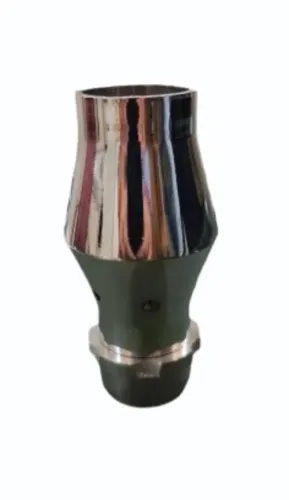
A stainless steel fountain nozzle suits continuously wet freshwater, with SS 304 often providing adequate corrosion resistance at a sensible cost. Choose SS 316 where chlorides, saltwater, salt-chlorination, fertiliser residue, chemical dosing, coastal air or repeated wet/dry cycling will concentrate contaminants. Neither grade is immune to pitting or crevice corrosion.
| Option | Water and site fit | Trade-offs |
|---|---|---|
| SS 304 | Freshwater basins with modest chemical exposure | Lower cost; less resistance to chloride pitting |
| SS 316 | Saltwater, salt-chlorinated pools, dosing systems and coastal sites | Better pitting resistance; still needs drainage and cleaning |
| PVC or ABS | Light-duty freshwater displays and chemically aggressive water | Light and corrosion-resistant; weaker threads, impact resistance and ultraviolet durability |
| Bronze or brass | Traditional decorative installations with compatible water chemistry | Repairable and machinable; can dezincify or corrode and may create galvanic problems |
The grade alone does not decide service life. A 316 nozzle can pit where chloride-bearing water evaporates around the lip, threads, welds or mounting plate, so eliminate stagnant crevices and provide drainage.
Keep stainless isolated from small brass, bronze, galvanised-steel or aluminium fittings with compatible fasteners or dielectric barriers; the smaller, less noble part can corrode rapidly.
Ask a 316L stainless steel nozzle supplier to identify the grade and heat or lot, not merely “stainless steel.” Confirm whether SS 304 or SS 316 applies to the body, orifice, threads, welds and internal parts, and request the PREN basis: %Cr + 3.3(%Mo) + 16(%N).
Inspect the parts that determine corrosion life
A weld can be the first failure point on an otherwise sound nozzle. Heat tint and chromium-depleted zones left on a welded stainless nozzle can corrode before the surrounding metal, especially in chlorinated or salty water.
Inspect these construction details before approval:
- Confirm the stated grade and heat or lot traceability for the nozzle body, orifice, threaded connection and internal wetted parts; “stainless steel” alone proves nothing.
- Look for continuous, even welds without cracks, undercut, trapped spatter or sharp crevices that retain water and chemicals.
- Ask whether the weld area was mechanically cleaned and descaled under ASTM A380, then treated with ASTM A967 passivation.
- Check whether the finish is genuinely clean metal rather than a polished surface hiding heat tint. Passivation restores the chromium-oxide surface; it does not remove heavy weld scale or repair poor weld geometry.
A corrosion-resistant fountain nozzle also needs compatible connections. Stainless joined directly to brass, bronze, galvanized steel or aluminium can create a galvanic cell in conductive water; a large stainless cathode can accelerate attack on a small anodic fitting. Specify dielectric isolation where appropriate, compatible fasteners and access for inspecting the less noble component.
Retain the approved drawing, orifice dimension, thread specification and surface-finish requirement. Those records let you reject a visually similar replacement that changes the wetted construction or introduces a new corrosion trap.
Verify hydraulics, dimensions and connection compatibility
A nozzle produces the intended display only when the pressure reaching its orifice matches the design point and the connection fits the supply line. Pump horsepower alone proves nothing: system losses can leave too little pressure for the required jet, while an oversized pump can overload the nozzle and distort the display.
Ask for these details before approving a nozzle:
- A dimensional drawing showing overall length, inlet diameter, orifice size and installation clearance.
- The fountain nozzle flow rate at a stated pressure, plus the fountain nozzle pressure range.
- The connection size and thread standard, such as BSP or NPT, including male or female orientation.
- The spray angle, expected trajectory and allowable installation orientation.
Use the stated flow and pressure point for pump sizing. Select a pump that delivers that flow after pipework losses, not its headline capacity at zero resistance. For a fixed nozzle, doubling pressure produces about 1.41 times the flow, not twice the flow, so a small pressure error changes height, coverage and pump demand.
Do not replace a decorative nozzle with an irrigation rain gun because both discharge water. Their flow pattern and hydraulic duty differ, creating splash, wind drift or an unstable display.
Retain the drawing, orifice size and flow-pressure data for replacements. A burr, weld intrusion or damaged orifice can bend a directional jet even when total flow looks correct; demand dimensional and hydraulic interchangeability across batches.
Design for installation, cleaning and future removal
A fountain nozzle installation should leave the orifice protected, the connection accessible and the jet adjustable without dismantling the basin. Flush pipework before fitting the nozzle; welding scale, sand or sealant fragments can lodge in a small passage and distort the spray. Install a strainer upstream where debris enters the circulation line.
- Tighten the connection to the maker’s instruction, not by gripping the orifice or using excessive force.
- Provide a union or removable coupling nearby so future removal does not require cutting pipework.
- Complete nozzle alignment after the system reaches operating pressure; a level mounting face prevents a directional jet from leaning.
- Keep the nozzle above settled sediment and allow access for inspection without standing in the water.
Fountain nozzle maintenance starts with scheduled fresh-water rinsing. Remove mineral deposits with a stainless-compatible method and a soft tool; chloride-bearing cleaners and abrasive wire brushes can scratch the surface and start localized corrosion. Clean the screen or insert before increasing pump pressure to correct a weak jet.
Record the installed nozzle’s orientation, orifice details and operating pressure. Replace damaged inserts rather than enlarging an opening on site. During removal, loosen the fitting carefully to avoid stainless thread galling, then cap the pipe to keep dirt out until the replacement is ready.
Use supplier documentation as the durability test
Approve the purchase only when the supplier’s documents let you identify the exact part, reproduce its performance and replace it later without changing the display. A polished finish or the words “stainless steel” do not prove grade, dimensions or hydraulic compatibility.
- Ask for a material certificate naming the stainless grade, heat or lot number, and the parts covered: body, orifice, threaded connection and internal components. Reject a certificate that identifies only the raw sheet or says “SS” without SS 304 or SS 316.
- Request a nozzle dimensional drawing showing overall length, outside diameter, orifice size, connection size, thread standard and sealing surface. Keep this drawing with the purchase record; it is the reference for future replacements.
- Require a flow-pressure curve for the exact nozzle size, plus the stated spray angle, trajectory and allowable installation orientation. Check the operating point against pressure at the nozzle, after pipe friction, filters, valves and manifolds.
- Ask how the supplier controls batch-to-batch interchangeability and records final inspection. Small changes in an orifice or thread can alter jet height, distort a directional stream or overload the pump.
For a Samudra Industries quotation, request these records for the specific nozzle style and connection size rather than accepting catalogue-level information. Missing documentation is a procurement risk: you cannot prove what was installed, diagnose a changed display or order a matching replacement.
Related products
 | Fountain Nozzle And Jet Nozzle 2.5 Inch 3 Stage Fountain Nozzle ₹1650 Add elegance and grandeur to large water features with the premium quality 2.5 Inch 3 Stage Fountain Nozzle. View product → |
 | Fountain Nozzle And Jet Nozzle 1 Inch Diamond Fountain Nozzle Samudra Industries Bring elegance and symmetry to your water features with the 1 Inch Diamond Fountain Nozzle from Samudra Industries. View product → |
Frequently asked questions
When should you choose SS 304 or SS 316 for a fountain nozzle?
Use SS 304 for continuously wet freshwater when contaminants are controlled. Choose SS 316 for chlorides, saltwater, salt-chlorination, fertiliser residue, chemical dosing, coastal air or repeated wet/dry cycling. Neither grade is immune to pitting or crevice corrosion.
Which nozzle parts reveal likely corrosion problems?
Inspect welds, threaded connections, sharp crevices, fasteners, wall thickness and surface finish. Poorly finished welds and trapped water create locations where corrosion can begin.
What compatibility checks should you complete before ordering?
Confirm flow rate, operating pressure, spray height, nozzle dimensions, inlet thread or flange size, pipe material and pump capacity. Check that the connection matches without forcing or using unsuitable adapters.
How should you plan installation and future removal?
Provide access for cleaning, leave room to remove the nozzle, use serviceable unions or isolation valves where appropriate, and prevent sediment from collecting around the inlet.
What supplier documents help assess fountain-nozzle durability?
Request the stainless-steel grade, dimensional drawing, connection details, operating data, weld or finish information, cleaning guidance, testing records and replacement-part details.
Related products
 | Fountain Nozzle And Jet Nozzle Samudra Industries Get Latest Price Create a sleek and powerful water display with the 1.5 Inch Vertical Jet Nozzle from Samudra Industries. View product → |
 | Fountain Nozzle And Jet Nozzle Samudra Industries Add a modern and dynamic touch to your water features with the 1 Inch Finger Fountain Nozzle from Samudra Industries. View product → |
 | Fountain Nozzle And Jet Nozzle 3/8 Inch Rain Dance Fountain Nozzle 1 Inch Diamond Cluster Fountain Nozzle – Samudra Industries Create a striking and dynamic water display with the 1 Inch Diamond Cluster Fountain... View product → |
 | Fountain Nozzle And Jet Nozzle 1"Inch Diamond Cluster Fountain Nozzle 3/8“ & 1/2” Inch Spray Fountain Nozzle – Samudra Industries Enhance your water features with the versatile 3/8“ & 1/2” Inch Spray Fountain Nozzle... View product → |