A pool’s volume gives you the starting flow calculation, not a complete pump specification. By the end, you will be able to calculate the required circulation rate, test a supplier’s pump curve at the real system resistance, and compare quotations for capacity, compatibility, operating cost and installation risk.
Key takeaways
- Calculate flow from pool volume, turnover time and daily filtration hours.
- Select the pump at total dynamic head, not horsepower or pool volume alone.
- Match pump speed to filter flow limits and the pool’s operating schedule.
- Require a written pump curve, motor details, connections and installation requirements.
How do you calculate the circulation flow your pool needs?
Calculate the required circulation flow from pool volume, the permitted turnover period for swimming pools and the hours available for filtration—not from pump horsepower alone.
1. Calculate pool volume in litres. Multiply length × width × average depth in metres, then multiply the result by 1,000. For an irregular pool, divide it into sections, calculate each section, and add the results.
2. Set the turnover period by checking the rule for your pool type and location. Residential pools, public pools, spas, wading pools and interactive water features do not share one universal target. Use the applicable local health-department or pool-code requirement.
3. Apply the pool circulation flow calculation: Q = V ÷ T. Q is flow, V is pool volume and T is the available operating time. A 30,000-gallon pool requiring a six-hour turnover needs about 83.3 gallons per minute before pipe, filter and equipment losses.
If filtration runs for only eight hours daily, divide the pool volume by eight hours rather than 24.
4. Treat that result as the design-flow starting point, then separate ordinary filtration from additional demand. A waterfall, fountain nozzle, spa jet, suction cleaner or backwash cycle can require a different flow and operating schedule. Confirm every mode against plumbing, health-department and pool code requirements.
Why must the pump be selected at total dynamic head rather than pool size?
Pool size tells you how much water must move; total dynamic head tells you how difficult it is to move that water. Pool pump sizing therefore starts with the design flow from the turnover calculation, then matches that flow to the system’s pipe resistance.
A narrow pipe or long run can create more resistance than a larger pool with short, straight pipework.
Ask the supplier to calculate total dynamic head using:
- Suction- and discharge-pipe lengths, diameters, elbows, tees, valves and elevation changes
- Filters, heaters, salt chlorinators, UV or ozone equipment
- Water features, including waterfalls, fountains and other added-flow demands
Read the pump performance curve at the required design flow and stated total dynamic head. Do not compare maximum-flow or headline horsepower figures: maximum flow is usually listed at zero or very low head, not at the head created by your installation.
| Figure requested | What it shows | Why it matters |
|---|---|---|
| Flow at stated head | Delivered circulation | Confirms the design flow |
| Total dynamic head | System resistance | Makes supplier quotations comparable |
| Input power and motor speed | Operating demand | Exposes energy and control differences |
| Efficiency at several points | Performance near duty | Shows whether the pump runs economically |
Check suction-side safety separately. Review drain-cover ratings, sump geometry, suction-pipe arrangement, isolation valves and entrapment-prevention provisions. A powerful pump cannot correct an unsafe suction design.
How should pump speed and filter limits shape the equipment choice?
Match the pump’s operating flow to the filter permitted flow rate and the lowest maximum-flow rating of every connected component: heater, chemical feeder, UV unit, ozone system, salt chlorinator and other treatment equipment. An oversized pump can raise filter differential pressure, create pipe noise and entrain air.
It can also force water through a treatment component too quickly, reducing contact time or exceeding its rated capacity.
| Pump type | Purchase and control | Best fit |
|---|---|---|
| Single-speed pool pump | Lower purchase price and simple controls, but full power whenever it runs | Pools with steady operating demand and limited speed-control needs |
| Two-speed pool pump | Lower-cost filtration setting plus a higher-speed setting | Pools needing separate filtration and cleaning or feature modes |
| Variable-speed pump | Higher initial cost, with longer, quieter low-speed filtration and timed high-speed modes | Pools with changing daily demands and features |
Under the affinity laws, 80% speed produces about 80% of the flow, 64% of the head and 51% of idealised power. System and motor losses change the exact result.
Require documented high-speed cases for:
- Priming and backwashing
- Heater minimum-flow requirements
- Suction cleaners
- Spa jets and fountains
The supplier must show that each mode stays within the filter and equipment flow limits. Select the duty point near the pump’s efficient operating region, rather than throttling an oversized pump with a valve.
Which pump specifications and installation details must the supplier confirm?
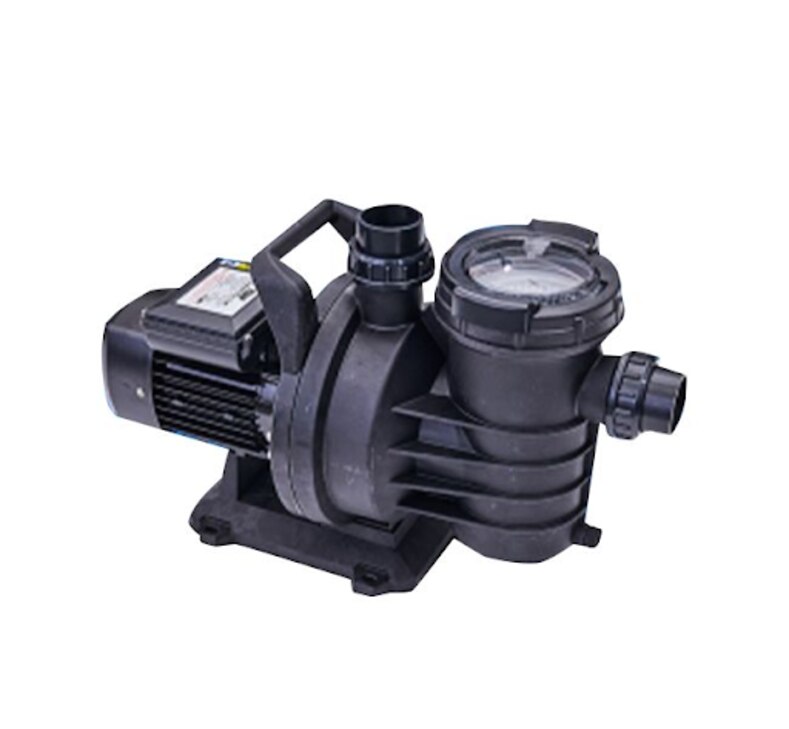
Require a written specification showing rated flow, flow at the stated total dynamic head, motor power, voltage, phase, frequency, inlet and outlet size, maximum head, self-priming capability, duty cycle and compatible filter flow rate.
Ask for the pump curve with flow, total dynamic head, input power, motor speed and efficiency at several points. The supplier must state the pipe lengths, diameters, fittings and elevation assumed behind that curve.
Confirm that the equipment is a self-priming pool pump for continuous treated-water circulation, not an intermittent fountain or irrigation pump. Nozzle pressure or rain-gun flow proves nothing about filtration, sanitation, priming or pool-water compatibility.
| Document item | What the supplier must state | Why it matters |
|---|---|---|
| Pool circulation | Design flow and filter flow range | Prevents excessive filter pressure |
| Construction | Wetted materials, mechanical-seal materials and elastomer compatibility | Salt, chlorine, ozone, low pH and heat can cause leaks or corrosion |
| Maintenance | Allowable water temperature and replacement-seal part number | Makes future repairs identifiable |
| Electrical supply | Motor voltage, phase and frequency, protective device and control requirements | Prevents an incompatible installation |
Before ordering, record suction and discharge connections, base dimensions, service clearance, cable route and control-panel space. Check pump installation dimensions India against the actual equipment pad and local wiring rules, or the rules in the installation country.
For public or commercial work, request the certification or listing required by the authority, including NSF/ANSI/CAN 50 where it applies. Certification of one pump does not certify the complete hydraulic installation.
How can you compare pool pump suppliers before placing the order?
Make a pool pump supplier comparison using one duty-point schedule, not each supplier’s largest motor or maximum-flow figure. Send every bidder the calculated pool volume, turnover target, daily operating hours, pipe sizes and lengths, elevation, fittings, filter model, treatment equipment and feature flows.
Use this pump quotation checklist:
- Design: design flow, total dynamic head with assumptions, pump curve, normal and high-speed modes, plus filter and equipment flow limits.
- Installation: voltage, phase, frequency, protective device, wetted materials and certification or listing evidence.
- Ownership: spare-parts availability, warranty terms and commissioning support.
| Quotation evidence | Accept | Reject |
|---|---|---|
| Flow basis | Flow at specified head with pump-curve data | Maximum flow only |
| Pump claim | Explains why the duty point suits the system | Says a larger pump is automatically safer |
| Service test | Defines post-installation checks | Provides no verification plan |
Ask how the supplier will verify priming, pressure, flow, noise, electrical protection and filter differential pressure after installation. Pool pump commissioning and warranty terms matter only when those checks have named acceptance criteria.
A Delhi or Delhi NCR supplier such as Samudra Industries adds value when it converts site measurements into a documented pump-and-system selection, rather than recommending horsepower alone.
Compare delivered performance, compatibility, service access and lifetime electricity cost; a cheap pump becomes costly if it runs at full speed, exceeds the filter rating or requires pipe and electrical changes.
Related products
 | Swimming Pool Products Samudra Industries offers high-performance Pool Pumps designed for efficient water circulation, filtration, and maintenance in swimming pools,... View product → |
 | Swimming Pool Products Samudra Industries offers premium-quality Swimming Pool Filters designed to maintain clean, hygienic, and crystal-clear pool water for residential,... View product → |
Frequently asked questions
How do you calculate the circulation flow your pool needs?
Divide pool volume by the required turnover period, then adjust for the hours available for daily filtration. Use consistent units, such as litres per hour or cubic metres per hour.
Why must the pump be selected at total dynamic head rather than pool size?
Total dynamic head combines elevation, pipe friction, fittings, valves, the filter and other equipment resistance. Select a pump that delivers the required flow at that head on its pump curve.
How should pump speed and filter limits shape the equipment choice?
Check the filter’s maximum flow rate and choose a pump speed that stays within that limit. Variable-speed pumps let you run lower flow for routine filtration and higher flow when equipment requires it.
Which pump specifications and installation details must the supplier confirm?
Confirm the pump curve, duty-point flow, total dynamic head, motor power and voltage, connection size, maximum flow, speed range, noise level, priming capability, materials and installation orientation.
Related product
 | Swimming Pool Products Pipe Less Filter Samudra Industries offers high-performance Pipe Less Filter systems designed for efficient water filtration in swimming pools,... View product → |