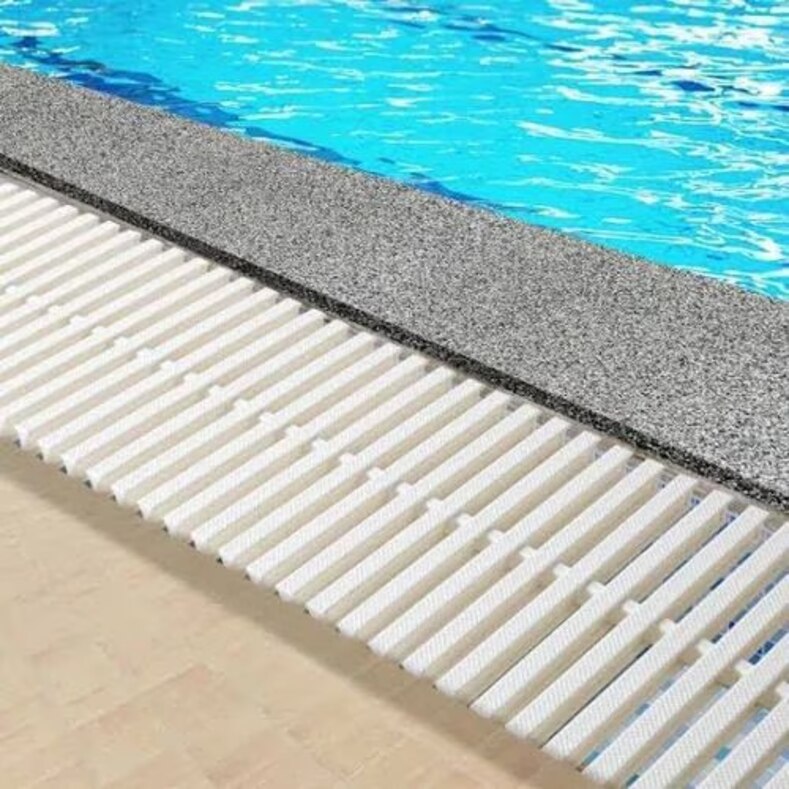
A perimeter overflow grating is part of the pool’s circulation system as well as its walking surface. By the end, you will know how to compare drainage layouts, measure replacement sections, test supplier claims and choose a material that matches the site’s water, traffic and maintenance conditions.
Key takeaways
- Measure every pool edge, corner, slot, gutter and transition before ordering.
- Match grating dimensions and load performance to the pool’s actual site conditions.
- Choose materials for chemical exposure, sunlight, standing water and cleaning routines.
- Request drawings, samples, specifications and installation guidance before approval.
How overflow grating controls water at the pool edge
In a perimeter overflow pool, water reaches the edge and passes through slots in the perimeter overflow grating into a continuous gutter. The gutter forms a deck-level pool channel, so waves and displaced water leave the basin around the perimeter instead of spilling across the deck.
From the gutter, water flows through outlets and pipework to a surge tank. The pool circulation system then filters, treats and returns that water to the basin. This arrangement equalises the water level and removes surface contamination, but grating alone cannot guarantee capacity.
The supplier must check gutter size, outlet dimensions, pipe routing, surge volume and peak inflow. Ample pool circulation system overflow grating free area will not prevent flooding if the channel or outlets are undersized.
Perimeter grating differs from covers designed only to hide a drain opening:
| Option | How water enters | Main purpose |
|---|---|---|
| Standard skimmer edge | Through a limited opening at one or more points | Removes surface water in a conventional pool |
| Trench drain cover | Through a linear channel beside the deck | Collects deck runoff or local drainage |
| Slot drain | Through a narrow concealed slot | Provides discreet drainage at a boundary |
| Removable channel grate | Through a channel beneath separate panels | Provides access to drainage and cleaning |
| Overflow grating | Through repeated slots around the pool edge | Captures continuous pool overflow and directs it to the surge tank |
Its flush, supported surface also matters: raised sections, wide joints or poor corner transitions can trip users and send dirty deck water into the pool.
What to measure before ordering grating
A grating that is 5 mm too high can create a trip lip, while a wrong support width can leave an unprotected gap beside the channel. Measure the existing installation at several points, not just once at a straight section.
- Record the channel width between finished support faces, plus the channel depth, support-rail width and bearing length available on each side.
- Measure each panel length and the module pitch: the distance from one connection centre to the next. Check hinge, clip, pin, lock and connector positions.
- Measure the total perimeter in straight runs, then separately count corner pieces and radius sections. Record each curve’s inside and outside radius; do not assume every corner uses a standard 90-degree part.
- Check the coping overhang, channel edge profile, adjacent deck finish and finished grating elevation. The top surface must meet the coping without a step.
- Mark expansion gaps, changes in level, ramps, end profiles and transition points. Ask for an installation drawing showing these interfaces before ordering.
- Compare the drawing with as-built measurements and request a physical sample. Confirm that sections remain secure but removable for gutter cleaning.
| Measurement or interface | What to verify | Failure if ignored |
|---|---|---|
| Channel width and supports | Clear width, rail position and bearing depth | Rocking sections or an open side gap |
| Panel length and pitch | Cut length, joint spacing and connector geometry | Misaligned joints or a continuous trip edge |
| Corners and curves | Corner pieces, radius sections and end profiles | Gaps, forced bends or unfinished terminations |
| Coping and deck level | Finished elevations and expansion allowance | Raised edges or water directed into the pool |
Which specifications determine safe poolside performance
Safe poolside performance depends on more than the grating’s material. Specify the load rating with its test method, support spacing, installation detail and intended traffic; “pedestrian duty” has no universal meaning. A panel supported continuously in a channel behaves differently from one spanning between narrow rails, and a maintenance cart can exceed foot traffic.
| Specification | Safety effect | What to verify |
|---|---|---|
| Load rating and allowable deflection | Prevents cracking, rocking and sudden failure under people or service equipment | Test load, span, support condition and maximum deflection |
| Opening geometry and rib spacing | Limits heel, toe and wheelchair-caster entrapment | Opening dimensions, rib spacing, module joints and slot direction |
| Surface texture | Maintains traction for wet bare feet without creating sharp, abrasive edges | Slip-resistant pool grating finish, rounded edges and cleanable profile |
| Installation details | Stops movement, height changes and drainage gaps from becoming trip hazards | Continuous bearing, secure connectors, flush deck level and movement gaps |
For an accessible route, apply the ADA rule that walking-surface openings must not allow passage of a 1/2-inch sphere. If an opening is elongated, orient its long dimension perpendicular to the dominant travel direction. Check the joint between every adjacent panel; a compliant individual panel can still create a dangerous slot at its transition.
Set the grating level with the surrounding deck, maintain firm support along its full length and secure corners and radius pieces against lift. Leave only the specified expansion clearance, because thermal movement can buckle a tight installation or loosen connectors.
How site conditions should guide the material choice
PVC is a practical choice for a sheltered residential pool with moderate foot traffic, predictable water chemistry and a replaceable channel system. It is usually easier to handle than metal, but pool chemicals, ultraviolet exposure and temperature cycling can cause discoloration, embrittlement, distortion or connector failure.
Compare materials against the conditions the grating will actually face:
| Material | Use it when | Check before ordering |
|---|---|---|
| PVC pool grating | The pool is indoors or partly shaded and the budget favours a lightweight, replaceable system | Confirm UV resistance, chemical resistance, operating temperature range and replacement connectors |
| Polypropylene grating | The installation needs a tougher thermoplastic option for chemical exposure or temperature changes | Request polymer-specific compatibility data; do not assume polypropylene is immune to sunlight or oxidising chemicals |
| 316L stainless steel | The pool has heavy public foot traffic, strong sunlight, high temperatures or a premium architectural finish | Specify 316L, weld-passivation and surface finish; check fastener compatibility and avoid water-trapping crevices because 316L can still pit |
| FRP or another reinforced material | Corrosive service and high stiffness matter more than a metal appearance | Verify load data, resin type, UV stabilisation, edge finish and repair or replacement arrangements |
Ask Samudra Industries for the polymer grade, stabilisation details, chemical-compatibility evidence and connector availability rather than accepting “UV resistant” as proof. Match the choice to the gutter supports and finished deck level; a durable material still fails if panels warp, lift or leave hazardous gaps.
Related product
 | Swimming Pool Products Samudra Industries is a trusted supplier of premium-quality Overflow Grating designed for efficient water drainage and safety in swimming pools,... View product → |
What a reliable supplier must prove before installation
A reliable supplier must prove how the grating performs in your channel, not merely label it “heavy duty.” Request documents before approving production: an installation drawing, test reports, material data and a written maintenance plan.
Ask for:
- The supplier load test method, including load class, support spacing, contact area, deflection limit, installation detail and intended traffic. “Pedestrian duty” is meaningless without these conditions.
- Conformity evidence against EN 13451-1 and the pool-equipment or drainage standards required in your jurisdiction. A generic CE mark or material certificate is not enough.
- Confirmation of the VGB suction-entrapment requirements where submerged suction outlets are involved. VGB evidence does not prove heel safety, pedestrian loading or gutter hydraulics for perimeter grating.
- The polymer type, UV-stabilisation provision, operating temperature range and chemical-compatibility data for chlorine, salt and cleaning agents.
- A maintenance schedule covering gutter cleaning, inspection for warping and connector replacement, with replacement connectors available for the full service period.
| Evidence | What it proves | What it does not prove |
|---|---|---|
| Installation drawing | Width, support rail, pitch, corner and expansion details | That an old channel matches |
| Load report | Performance under stated test conditions | Safety under different supports or vehicles |
| Physical sample | Fit, clip position and end profile | Long-term chemical resistance |
| Maintenance plan | Safe removal and cleaning access | Permanent resistance to displacement |
Check the drawing against verified as-built measurements before ordering. The supplier must show how sections resist flotation and lateral movement yet remain removable without leaving trip lips or gaps.
Frequently asked questions
How does overflow grating control water at the pool edge?
Slots in the perimeter grating let displaced and wave-driven water enter a continuous gutter instead of spreading across the deck.
What should you measure before ordering pool overflow grating?
Measure each straight run, corner, transition, gutter opening and support detail, then confirm the required grating width and length.
Which specifications affect safe poolside performance?
Check slot dimensions, surface grip, load capacity, dimensional accuracy, chemical resistance and compatibility with the gutter and deck.
How should site conditions guide the grating material choice?
Base the choice on chlorine or salt exposure, ultraviolet light, standing water, cleaning chemicals, temperature and expected foot traffic.
What must a reliable overflow grating supplier prove before installation?
Request material details, dimensional drawings, performance data, samples and installation instructions that match your pool and gutter design.