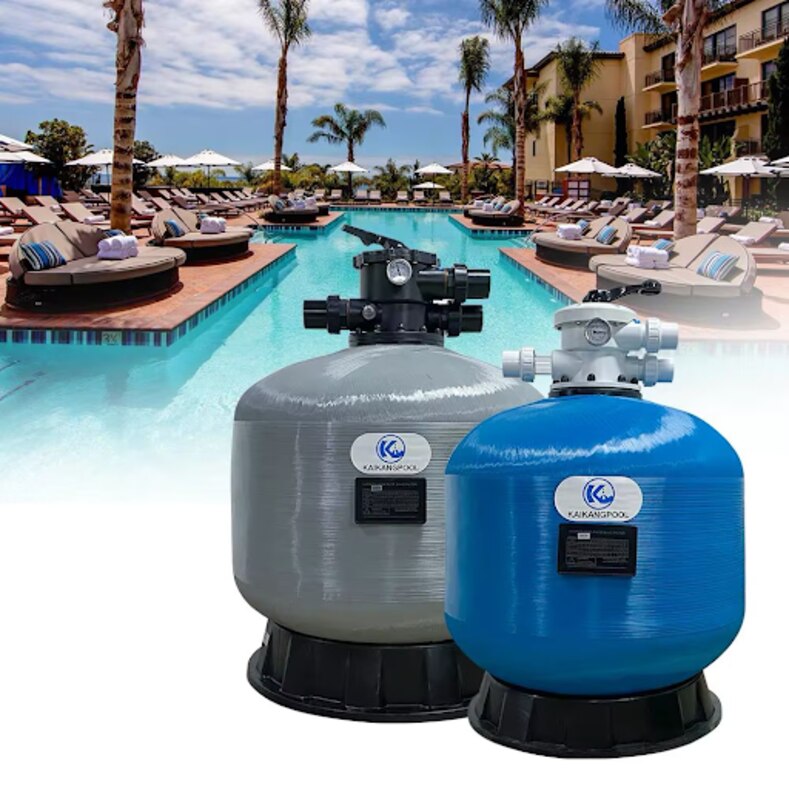
The correct filter starts with the water flow your pool requires, then extends to pipework, pump performance, contamination load, maintenance access and disposal arrangements. By the end, you will know which measurements to give a supplier, how to compare filtration methods, and which technical details to obtain before ordering.
Key takeaways
- Calculate design flow from pool volume and required turnover time.
- Compare sand, cartridge and diatomaceous-earth filters by maintenance workload.
- Size the pump, filter and pipework together as one hydraulic system.
- Request written proof that equipment fits the site and remains serviceable.
Start with design flow, turnover and the pool’s actual site conditions
Start with the required design flow rate, not the pool volume alone. Calculate pool volume in litres, convert the required turnover time to minutes, then use: design flow rate (LPM) = pool volume ÷ turnover time. A 120,000-litre pool requiring a six-hour turnover needs 120,000 ÷ 360 = 333 litres per minute.
In cubic metres per hour, divide 120 m³ by six hours: 20 m³/h.
| Calculation or input | What to establish | Why it affects selection |
|---|---|---|
| Pool volume | Water volume in litres or cubic metres, including connected tanks | Sets the circulation volume |
| Turnover time | The period required by the local health code for the pool type | Determines the minimum design flow rate |
| Pump performance | Flow at the system’s operating head, not the pump’s label alone | Confirms the filter will receive the required flow |
| Site load | Bather numbers, sunscreen, body oils, debris, source-water turbidity and fountain overspray | High solids or organic loads can require more filter area or prefiltration |
Before choosing a vessel, provide:
- Pool type, operating schedule and governing jurisdiction
- Pipe lengths, diameters, elevation changes, valves and shared water features
- Available backwash flow and waste-pipe capacity for sand or diatomaceous-earth filters
- Space for access, cartridge removal, media replacement and pressure-relief equipment
Ask for the proposed filter’s effective area, filtration rate, maximum flow and clean-filter pressure at the calculated design flow. Record that clean pressure during commissioning; gauges and pipework differ, so one universal pressure number is unreliable.
Compare sand, cartridge and diatomaceous-earth filtration by total workload
Choose the medium that matches your water quality and your willingness to clean, waste water and store supplies. A low purchase price becomes expensive if the filter needs frequent attention or the site cannot discharge contaminated water.
| Option | Water and operating profile | Total workload |
|---|---|---|
| Sand filter | Durable, lower-cost filtration with a higher allowable filtration rate than many cartridge systems; confirm its filtration rating in microns | Needs a backwash circuit, waste-pipe capacity and a disposal route; backwashing uses water and removes the filter from service |
| Cartridge filter | No backwash line and lower routine water loss; useful where drainage or water supply is restricted | Remove, wash and inspect cartridges manually, then replace damaged or exhausted elements; undersizing causes rapid fouling and frequent cleaning |
| Diatomaceous earth (DE) | Produces finer particle removal than ordinary sand; useful when clearer water is the priority | Requires DE replenishment, spent-media handling and disposal; local rules may restrict discharge of DE-containing backwash water |
Compare effective filter area, not connection size. Two vessels with the same port diameter can have different allowable flows and cleaning intervals.
For sand or DE, verify the required backwash flow against the pump, valve arrangement and waste pipe before purchase. A shared pump serving fountains or other water features can circulate the pool correctly yet fail to expand or clean the media.
Ask for the manufacturer’s design filtration rate, effective area and maximum working pressure; choose a cartridge filter only if you can access and wash its elements safely.
Match the filter, pump and pipework as one hydraulic system
Prevent excessive pressure and poor flow by selecting the pump, filter and pipework from one system curve, not by matching motor size to the filter’s port diameter. The curve must include static lift, pipe and fitting friction, heater resistance, treatment equipment and the filter’s clean and dirty pressure losses.
A filter’s advertised maximum flow is not the flow your installation will deliver.
Compare the manufacturer’s specified pump flow with the filter’s recommended flow, filtration rate and effective filter area. A larger pump does not compensate for insufficient filter area: it raises loading, pressure drop and cleaning frequency, and can exceed the tank, valve, heater or pipe rating.
Compare vessel diameter as well as connection size; identical ports can conceal different internal areas and flow limits.
Before ordering, require these figures for the complete assembly:
- Design flow and clean-filter pressure at that flow
- Maximum working pressure for the filter vessel, valve, heater and pipework
- Connection type, nominal size and adaptor requirements
- Required backwash flow and the waste-pipe capacity
- Valve arrangement, pressure-relief provisions and isolation points
Record clean pressure during commissioning. Use it as your site baseline, then clean the filter at the manufacturer’s stated pressure rise or when flow falls below the required rate.
A shared pump serving a fountain or other feature can leave a sand or DE filter unable to reach its backwash velocity, even when normal circulation appears satisfactory.
Use pressure, valve positions and maintenance symptoms to find the real problem
Record the pressure gauge reading after a clean filter has been primed, the pump is running at its normal speed, and all operating valves are correctly positioned. This is your clean-pressure baseline. A steady rise above that reading indicates increasing filter resistance, not automatically a failing pump.
Switch off the pump before moving a multiport valve. Follow the manufacturer’s sequence for Filter, Backwash, Rinse and Waste; never rotate the valve under pressure. Open the air-release arrangement before servicing, and confirm that the pressure-relief device, tank, valve and pipework remain within their rated limits.
A closed return valve or trapped air can create a dangerous pressure condition.
Use these symptoms to separate the fault:
- High pressure with weaker returns usually means a dirty sand or diatomaceous-earth filter, a blocked return, or an incorrectly set valve. Perform backwashing only where the system has a backwash line and disposal route.
- Low pressure with weak returns points to a blocked skimmer or suction line, low water level, an air leak, a closed suction valve or a pump-basket blockage.
- Normal pressure with cloudy or green water points to chemistry, inadequate circulation time or contamination entering the pool, not a dirty filter alone.
- Normal pressure with oily film, scum or staining at the waterline indicates a surface or bather-load problem.
For a cartridge system, isolate and depressurise the housing before cartridge cleaning. Remove, wash between pleats, inspect for tears and replace damaged or permanently deformed cartridges. A rapid return to high pressure means the cartridge is undersized, damaged or the water load remains unresolved.
Request a written selection that proves the equipment will fit and remain serviceable
Before you pay, ask for a written selection sheet that proves the filter suits your hydraulic design, installation space and maintenance plan. A model number alone cannot show whether it will circulate, backwash or receive service access safely.
1. State the design flow, recommended flow rate, effective filter area, filtration rate, clean operating pressure and maximum working pressure. Include the governing health-code turnover requirement used for the calculation.
2. Record the vessel dimensions, clearance needed to remove cartridges or access the valve, connection size, valve arrangement and pipe sizes. Confirm that the inlet, outlet, waste and drain connections match your drawings.
3. Show the required backwash flow, pump duty at that flow, waste-pipe capacity and disposal route. A filter that works during circulation can still fail to clean its media if the shared pump or drain cannot deliver the backwash requirement.
4. List the specified media or cartridge part number, initial quantity, replacement media cost and expected change-out procedure. Ask for written availability details rather than accepting “easy to source.”
5. Attach warranty terms, exclusions, pressure limits, commissioning steps, test records and the maintenance manual. The documents should identify who checks leaks, valve operation, pressure readings and initial water quality.
Samudra Industries can be asked to place these figures on a project-specific quotation instead of supplying a generic filter description. Reject the selection if any value conflicts with the pump curve, site measurements or approved pipe layout; correcting that mismatch after installation costs more than checking it beforehand.
Related products
 | Swimming Pool Products Samudra Industries offers premium-quality Swimming Pool Filters designed to maintain clean, hygienic, and crystal-clear pool water for residential,... View product → |
 | Swimming Pool Products Pipe Less Filter Samudra Industries offers high-performance Pipe Less Filter systems designed for efficient water filtration in swimming pools,... View product → |
Frequently asked questions
How do you calculate the required swimming pool filtration flow rate?
Calculate pool volume in litres, convert the turnover time to minutes, then divide pool volume by turnover time. A 120,000-litre pool with a six-hour turnover requires 333 litres per minute.
How do sand, cartridge and diatomaceous-earth filters differ?
Compare them by cleaning method, pressure behaviour, maintenance time, water use and the workload your site can support.
Why must the pool pump, filter and pipework be selected together?
The pump must deliver the design flow through the filter and pipework without excessive pressure, restricted flow or inefficient operation.
What should a written filter selection include?
Ask for the design flow, turnover basis, filter model, pump duty, pipe sizes, connection details, valve positions, installation clearances and maintenance access.
Related product
 | Swimming Pool Products Samudra Industries offers high-performance Pool Pumps designed for efficient water circulation, filtration, and maintenance in swimming pools,... View product → |